
July 11, 2026
Topic Cspii-monitor Topic Christians Topic Sharia
Two recent articles attempt to calm American concerns about Sharia by changing the subject.
The first, Salam Al-Marayati’s “Sharia is a framework for Muslims — not a threat to America,” presents Sharia as a spiritual and moral path, a set of ethical objectives supposedly aligned with the U.S. Constitution. The second, “Why this evangelical pastor rejects fear of Shariah,” co-authored with Pastor Jon Fogel, adds an interfaith layer: the Muslim family next door is kind, trustworthy, generous, and loving, and therefore Christians should reject “fear” of Sharia.
The argument is emotionally attractive. It is also evasive.
No serious critic of Political Islam argues that every Muslim neighbor is a threat, that Islamic families cannot be kind, or that Muslims should be denied the right to pray, fast, give charity, attend mosques, raise families, or live freely under US law. That is a false frame. The real question is not whether Muslims may practice Islam privately without disruption of public life or limiting others by doing so. In America, of course they may. The real question is whether Sharia, as a legal and political doctrine, is accurately described when it is reduced to neighborliness, compassion, “moral objectives,” and constitutional loyalty.
The answer is no.
The two articles rely on three underlying fallacious assertions. First, they redefine Sharia upward into non-existent ideals and away from very concrete legal principles. Second, they dismiss public concern as political manipulation or “hysteria.” Third, they describe personal stories and experiences about good Muslims instead of having a sober discussion of Islamic legal framework. None of these assertions answers the central concern.
Sharia is not merely “the way” in the vague sense of spiritual fulfillment. It is not merely a private devotional ethic. It is the Islamic concept of divine law. It covers worship, family, inheritance, contracts, sexual conduct, criminal punishment, relations between Muslims and non-Muslims, and the correct Islamic order of society. It is true that Islamic jurisprudence is diverse – to give an example, some schools of Sharia say FGM (female genital mutilation) is mandatory, while others only encourage it. It is true that Islamic-majority countries apply Islamic law selectively. It is true that many Muslims in America accept the Constitution as the law of the land even when Sharia dictates them not to. But none of that changes what Sharia is.
Al-Marayati’s article presents Sharia as a “framework of moral objectives” protecting life, thought, religion, family, and property. This is the familiar “maqasid al-shariah” argument. It sounds liberal because it translates Islamic legal objectives into language US citizens associate with rights. But the translation is doing much of the work.
In classical Islamic law, “protection of religion” does not necessarily mean freedom of conscience in the usual non-Islamic understanding. It can mean protecting Islam from criticism. “Protection of family” does not necessarily mean equal family law for men and women. It can mean preserving Islamic rules governing marriage, divorce, custody, inheritance and sexual morality. “Protection of intellect” does not necessarily mean unrestricted freedom of thought and expression. It can mean suppressing intoxication, heresy, blasphemy, or speech understood to corrupt belief. “Protection of property” does not automatically mean a secular liberal property regime. It may include Islamic rules about waqf, zakat, inheritance, interest and commercial conduct.
This is the core fallacy of the rebrand: Islamic legal objectives are described using liberal-sounding words, while the legal meanings those words often carry inside Sharia are left unexplained.
The same problem appears in the use of Koran 5:48. Al-Marayati quotes the verse as evidence of pluralism: “To each of you We have prescribed a different law and way of life.” But the broader verse also commands judgment by what Allah has revealed and warns against following other desires. Whatever else one makes of the verse, it is not a simple endorsement of liberal constitutional order. It is not the First Amendment. It is a statement inside an Islamic revelation about divine law, religious communities, and obedience to Allah.
The articles also lean heavily on the claim that Muslims are only about one percent of the U.S. population and therefore lack the capacity to impose anything on the rest of the country. This is a demographic argument pretending to be a legal argument.
A doctrine does not become harmless because its adherents are a minority. The question is not whether American Muslims can seize Congress tomorrow morning. The question is whether Islamic institutions, activists, legal advocates and interfaith partners are normalizing a misleading account of Sharia in American public life.
In that sense, the small-minority argument diverts the focus.. The concern is not imminent electoral takeover. The concern is ideological whitewashing.
Pastor Fogel’s contribution intensifies the diversion. His Muslim neighbors are, by his account, good people. He trusts them with his children and his house key. That may be admirable. It is also irrelevant to the legal question.
A kind Muslim neighbor does not define Sharia. A generous Muslim family does not erase Islamic jurisprudence. A warm interfaith dialogue does not answer questions about apostasy, blasphemy, jihad, hudud punishments, unequal inheritance, polygyny, the status of women, or the status of non-Muslims under Islamic governance. To say this is not to attack the neighbor. It is to refuse the manipulation by which criticism of a legal-political doctrine is recast as suspicion of ordinary people.
This is one of the most common tactics in the defense of Political Islam: move constantly between Muslims as persons and Islam as a system. When Islam is criticized, point to decent Muslims. When Sharia is questioned, talk about hospitality. When political doctrine is examined, accuse the examiner of fear, exclusion, or bad faith.
That is not moral seriousness. It is evasion.
The articles do make one valid point: there is no single “Sharia state.” Saudi Arabia, Iran, Egypt, Turkey, Afghanistan, Pakistan, Malaysia, Nigeria and other Muslim-majority societies differ widely. But this point refutes a cartoon version of the criticism. The problem was never that every Muslim-majority country has the same legal code. The problem is that Sharia contains recurring legal categories, objectives and doctrines that are fundamentally different from – and incompatible with – secular constitutional law.
Attempting to separate Sharia and fiqh does not solve the problem. Al-Marayati says that legal rulings associated with Sharia are human interpretation, fallible, and historically contingent. That is true as far as it goes. But it does not make those rulings irrelevant. The entire practical meaning of Sharia in society is mediated through jurisprudence, courts, scholars, clerics, institutions, and political movements. If every concrete ruling can be dismissed as “only interpretation,” then Sharia becomes immune to criticism by definition. Its ideals are praised, while its applications are disowned.
That is not an honest standard. No other legal or political tradition is treated this way.
So what is Sharia? It is the legal application of the doctrine found in the Koran and Sunna, of Allah and Mohammed.
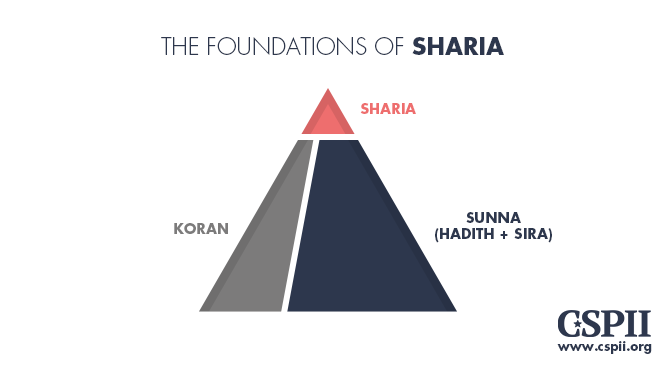
The Sharia has different schools of thought that differ on small issues. However, all of the schools agree on the need forjihad and the inferior status of Christians, Jews, atheists and other Kafirs. Kafirs are forbidden by Sharia to contradict or argue about the Koran and the Sunna or criticize Mohammed. Historically, it is the Sharia, in combination with jihad, which assured annihilation of Christianity in North Africa, Buddhism in Afghanistan, Hinduism in Pakistan, Zoroastrianism in Iran... and the list goes on.
We should not evaluate Sharia only by its public-relations vocabulary while ignoring the legal tradition that has carried its name for centuries.
The constitutional issue is also more serious than the articles admit. The American Constitution protects religious exercise. It does not make religious law sovereign. A Muslim may voluntarily follow Islamic dietary rules, prayer obligations, marriage customs, or private ethical norms as any other law-abiding U.S. citizen. That is religious liberty.
But the Constitution does not become “an expression of Sharia” simply because a Muslim says obeying it is part of his faith. The Constitution rests on civil sovereignty, equal citizenship, free speech, freedom of conscience, religious disestablishment and the right to change or reject religion. Any system is compatible with that order only to the degree that it subordinates its public legal claims to constitutional law.
That is the point the two articles blur. They ask Americans to accept Sharia as benign because some Muslims choose to practice in a Constitution-friendly way. But the relevant civic question is not whether Constitution-friendly Muslims exist. The question is whether Sharia itself, when treated as law and not merely private spirituality, is compatible with the principles of a free society.
The answer cannot be supplied by slogans about mercy and justice. Every comprehensive ideology advertises moral ends. The issue is the means, the legal content, the authority structure and the treatment of those who disagree.
If Sharia were only private devotion, then Americans have no reason to fear it and no reason to politicize it. But since Sharia is a public legal framework, then Americans have every right to examine it. If Sharia governs only a Muslim’s prayer, fasting, and charity, it is protected by law.. If Sharia claims authority (which it does) over speech, family law, criminal punishment, women, apostates, blasphemers, converts, sexual minorities, non-Muslims, or the state itself, then it becomes a political question.
Pastor Fogel writes as if the Christian duty to love one’s neighbor requires Christians to stop worrying about Sharia. But love of neighbor is not the suspension of judgment. It is perfectly possible to accept and respect Muslims as people, defend their civil rights, and still reject Sharia as a model for law and society. In fact, such clarity is essential. A free society protects people; it does not have to flatter every doctrine those people may hold.
The proper American answer is simple: Muslims are equal citizens. Islam is open to criticism. Sharia has no authority over American law. Private religious observance is protected. Political Islam should be scrutinized. No citizen should be mistreated because he is Muslim, and no legal doctrine should be immunized because its defenders accuse critics of fear.
That is the balance the two articles refuse to maintain.
By turning Sharia into a cloud of moral aspirations, Al-Marayati avoids the hard questions. By turning his Muslim neighbors into the centerpiece of the discussion, Fogel avoids them too. Together, the articles offer not an explanation of Sharia, but a public-relations strategy: soften the word, personalize the issue, pathologize the critic, and move the debate away from law.
Americans should not accept that bargain.
The question is not whether Muslims can be good neighbors. The question is whether Sharia, as a legal-political doctrine, deserves to be treated as compatible with constitutional liberty without scrutiny. It does not.
And asking that question is not hysteria. It is civic responsibility.