
May 3, 2026
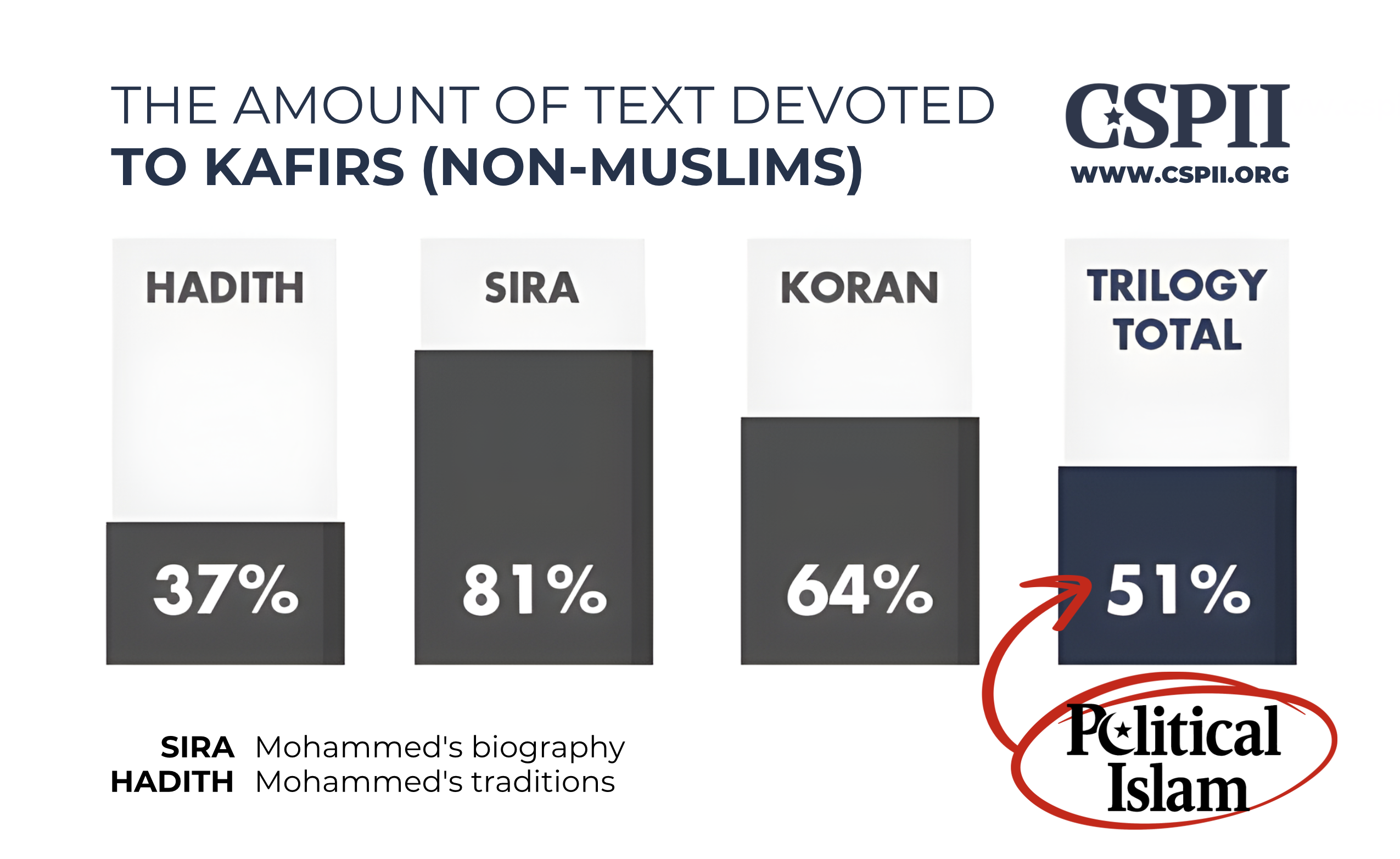
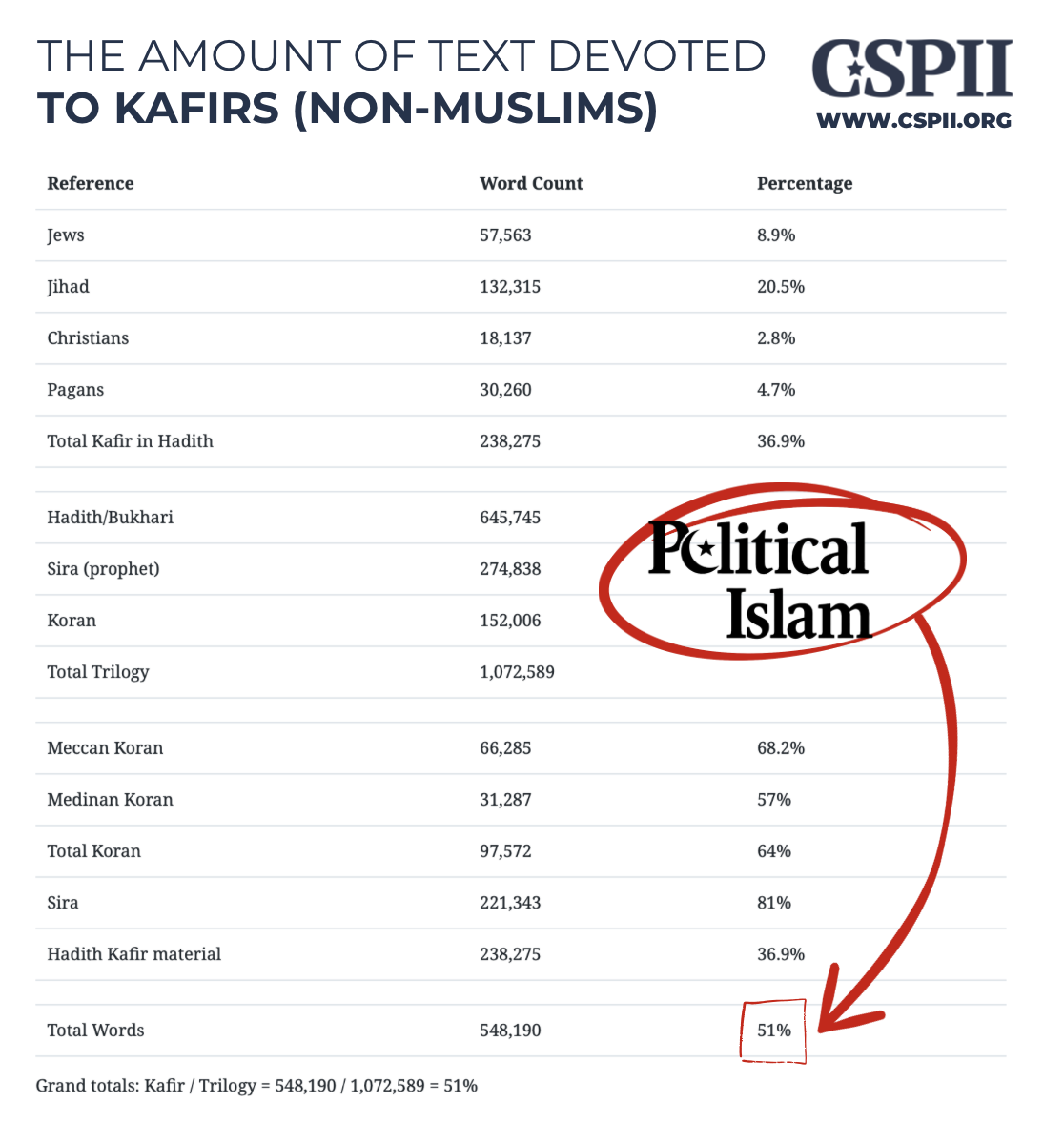
Dr. Bill Warner, the co-founder of CSPII, found during his research of Islamic doctrine that there is an immense amount of prescriptive text directed toward non-Muslims and decided to quantify it. He carefully counted this amount of text and ended up with the figure of 51%. This textual body divides the world into two groups “us” (Muslims / Umma) and “them” (Kafirs - a derogatory word for non-Muslims). This division is not politically neutral. Kafirs are dehumanized, even described as “worst of created beings” (Koran 98:6). This is, from non-Islamic point of view, political. Therefore the choice of the name “Political Islam.” We urge everyone to study and use Critical Discourse Analysis (CDA) and the Political Discourse Analysis (PDA) in the context of Islamic doctrinal research.
It is entirely true that, from the Islamic point of view, the Islamic doctrine (Islam) is one—politics and religion are inseparable. However, by accepting this point of view of an undivided doctrine, you must operate, to certain extent, within the already predefined formal Islamic setting that is widely rooted in non-Islamic societies (such as the incorrect definition of Islam within non-Islamic legal systems, academia influenced by Islamic scholars and funding, and politicians unknowingly influenced by dawa, etc.). This leads to becoming stuck in the emotional “quicksand” of theology instead of switching to the free range of pragmatic politics.
Political Islam creates new non-Islamic formal framework, shifting control of the subject from Islamic authorities to non-Islamic ones. While Islamic authorities strategically position themselves, and are generally accepted, as the “go-to” sources on Islam, they are provably incompetent in the field of Political Islam. Why? Their own doctrine does not allow to extract Political Islam from Islamic doctrine and treat it as a separate political system. Those authorities are submitted to Mohammed and Allah, and, therefore can face a death penalty if considered non-Muslim for critically examining their own doctrine. This disqualifies Islamic authorities as experts on Political Islam, as a political ideology, in full. This approach makes the subject accessible through a new, non-Islamic analytical lens. Therefore, using Political Islam gives not only tactical, but strategic advantage in any debate, policy discussion or by addressing any national and/or international security issue. By using Political Islam, Islamic "competition" becomes irrelevant and obsolete. A correct definition and use of Political Islam redefines whole market with information and shifts the power center from Islamic to the non-Islamic one.
Using a precise definition of “Political Islam” enables the subject to be recategorized and de-religionized, moving it away from the field of theology into the fields of national security, political science, and political geography. This is where, from a non-Islamic point of view, Political Islam—an embedded political ideology within the primary Islamic doctrine itself—belongs.
While more and more people are ready to outlaw Sharia, there is hesitation by many to address the foundation of Sharia - Islamic doctrine itself which is perceived as religious (or religious as well). Those who oppose Sharia are empowered because it is primarily a legal and political concept. That's why it makes it easier to target. Our precise definition of Political Islam, as a political ideology, enables to treat this part of the Islamic doctrine accordingly.
Once the separation is made, clergy, politicians, academics, national security professionals, and others can discuss (and address) Political Islam as they would any other political ideology—in a clear, structured, non-emotional, and, most importantly, non-religious manner. This surgical approach makes it easy to introduce the discussion into a wide range of settings. It is strongly empowering. It switches the discourse from a short term tactic into a long-term strategy.