
Introduction
Over the past two decades, Islamic organisations have been a recurrent topic of public debate in Switzerland (Sanchez-Mazas, 2023; Baycan-Herzog and Gianni, 2019; Gianni, 2016; Monnot, 2016; Sarrasin, 2016). As Dr. Elisa Banfi mentioned, in Switzerland “at the federal legislative level, the National Council as well as State Council have increasingly coped with parliamentary objects concerning Islamic organisations over the last twenty years” (Banfi, 2021). Swiss researchers have conducted in-depth investigations of the networks of Islamic organisations in different local and national contexts in Switzerland (Banfi and Gianni, 2023; Schneuwly Purdie, 2024; Banfi, 2018; Giugni et al., 2013). Multidisciplinary research on Islamic organisations in the West (Peucker and Ceylan, 2017), in the USA and Europe (Rosenow-Williams, 2012; Cesari, 2014; Allievi and Nielsen, 2003) reveals their heterogeneous organisational forms, strategies, and practices (Kortmann and Rosenow-Williams, 2013). Some European universities develop maps of Islamic organisations. For example, the Department of Islamic-Theological Studies at the University of Vienna has mapped Austrian Islamic organisations in a project called IslamLandkarte (IslamLandkarte, 2013).
As Dr. Banfi notes, the research process faces the problem of obtaining high-quality data on Islamic organisations, and verification of reliability of information sources is necessary (Banfi and Gianni, 2023).
With the reliability of the data source as our top priority, we have decided to analyse such a reliable source as the Swiss Federal Registry of Commerce (Dataset, 2022). We have developed a methodology on how to extract data on Islamic organisations from this Registry using keywords to obtain a relevant sample. It should be taken into account that the data obtained in this way are limited, and contain information from this Registry only.
It should also be noted that the maps presented in this article do not reflect diversity and heterogeneity of Islamic organisations, as it was not the purpose of this research. The purpose of these maps is to visualise a general picture of how Islamic organisations have been distributed across theSwitzerland as a whole, over the last 64 years. Further research may be devoted to the diversity of forms and activity types of Islamic organisations.
The main goal of the research presented in this paper is to support public debates on the topic of Islamic organisations in Switzerland with clear factual information based on reliable sources.
This paper provides a detailed description of the methodology used to collect the data; maps of Islamic organisations for 1958, 2000 and 2022; a graph of organisational growth in number over 64 years; a list of 47 localities where 102 Islamic organisations are registered as of 2022; a dynamics and trend analysis by decades of the annual number of registered and liquidated Islamic organisations in Switzerland from 1958 to 2022.
1 Methodology
We have developed a methodology for collecting, visualising and analysing data on Islamic organizations in Switzerland.
The methodology consists of three stages:
1) Identification of data sources and the use of key words to collect data;
2) Generation of maps for each year from 1958 to 2022;
3) Quantitative analysis of the data.
1.1 Stage 1. Identification of data sources and use of key words to collect data
One of the functions of a state is to register organisations active in its jurisdiction. In modern societies transparency plays an important role, ensuring that citizens can exercise their right to be informed and have access to information. Consequently, in many countries registers of organisations are publicly accessible, usually through websites equipped with search engines.
Our source of data was the ‘Central Business Name Index’ – official website of Swiss Federal Office of Justice,
Federal Registry of Commerce, Bundesrain 20, 3003 Bern, as indicated at the contact page https://www.zefix.ch/en/contact. This is a publicly accessible portal with information on organisations registered in Switzerland, both active and liquidated. We accessed the data on the 15th of September 2022 at https://www.zefix.ch.
When registering, each organisation specifies its own name. An organization can, at its own discretion, reflect Islamic affiliation in its name.Information on this kind of organisations was extracted from the Registry. The Central Business Name Index gives the possibility to search for an organization by a keyword that is part of its name. We have identified organisations whose Islamic affiliation is reflected by their names by searching for key words in English, German, French and Italian. The following 23 key words were found in the names of Swiss organisations.
Variants of "Islam":
- Islam – 2 organisations
- Islamic – 10 organisations
- Islamica – 1 organisation
- Islamico – 1 organisation
- Islamique – 17 organisations
- Islamisch – 60 organisations
Variants of "Muslim":
- Muslim – 6 organisations
- Muslime – 2 organisations
- Muslimische – 3 organisations
- Musulman – 11 organisations
- Musulmani – 1 organisation
Variants of "Mosque":
- Moschee – 6 organisations
- Mosquée – 1 organisation
Variants of "Koran":
- Koran – 1 organisation
- Quran – 2 organisations
Miscellaneous words:
- Halal – 22 organisations
- Hijab – 2 organisations
- Imam, means "Islamic leader" (Ibrahim, 2023) – 1 organisation
- Madrassah, means "Islamic school" (Ibrahim, 2023) – 2 organisations
- Sharia, means "Islamic law" (Ibrahim, 2023) – 1 organisation
- Sunnah, means "Mohammed’s tradition" (Ibrahim, 2023) – 2 organisations
- Ummah, means "the unified Islamic community" (Ibrahim, 2023) – 1 organisation
- Zakat, means Islamic obligatory charitable payment, one of the Five Pillars of Islam (Ibrahim, 2023) – 2 organisations
Each organization’s name was checked manually to ensure there is no mistake. As a result, we had a list of Islamic organisations from the Central Business Name Index with all the data necessary for mapping. It should be noted that the data are limited by the date of commencement of the Registry and the quality and accuracy of the source itself.
1.2 Stage 2. Generation of maps for each year from 1958 to 2022
Using the data obtained in Stage 1 we have created a table of the following data: a unique ID for each organisation, the organisation’s name, the locality where the organisation was registered, the year of its registration and, where applicable, the year the organisation was liquidated. The data was processed with the software R (4.2.1) for generation of the maps using the packages ‘ggplot2’ and ‘maps’. The coordinates of the localities were obtained from the Nominatim (https://nominatim.org).
For every locality, we have calculated the number of Islamic organisations registered and liquidated each year. On the maps, each locality is represented by a circle centred on its coordinates. The circle’s diameter corresponds to the number of Islamic organisations there: the larger the circle’s diameter is, the more Islamic organisations were there (see Fig. 1). This way of presenting the data ensures that neither the name nor the address of the organisations is disclosed.
To reflect the dynamics over time, maps were made for each year from 1958, when the first Islamic organisation appears in the Registry, to 2022, the year we accessed the data. Each map corresponds to one year and depicts only organisations having ‘active’ status (i.e. not liquidated) at the end of the year.
As a result, we had a series of 64 maps from 1958 to 2022. When viewed in sequence, they reflect the dynamic over time. Each map has circles of different diameters at the localities where Islamic organisations were present, and is labelled with the year and the total number of Islamic organisations with ‘active’ status.
1.3 Stage 3. Quantitative analysis of the collected data
The quantitative analysis includes:
- changes in the number of Islamic organisations in Switzerland since 1958;
- Swiss localities and corresponding numbers of Islamic organisations as of 2022;
- the number of registered and liquidated Islamic organisations each year since 1958.
2 Results
2.1 Maps of Islamic Organisations in Switzerland from 1958 to 2022
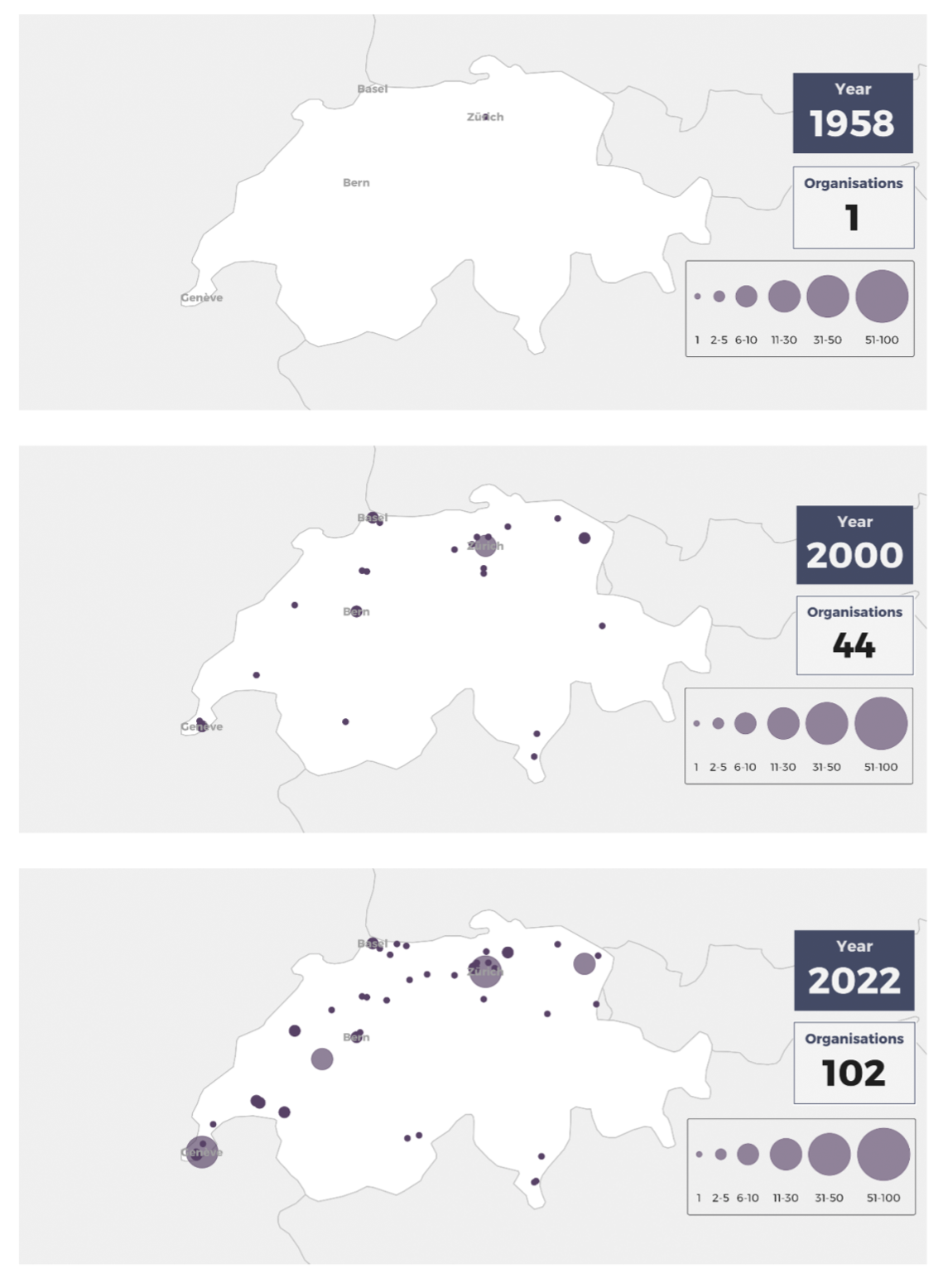
Figure 1: Maps of Islamic organisations in Switzerland in 1958, 2000, and 2022 according to the Central Business Name Index.
Figure 1 displays maps of Islamic organisations in Switzerland having ‘active’ status in 1958, 2000, and 2022.
According to the collected data, 158 Islamic organisations were registered in Switzerland between 1958 and September 2022. Of these, 102 were still active in 2022, and 56 had been liquidated. The maps in Fig. 1 display only organisations with ‘active’ status in the relevant year – they do not display organisations that had been liquidated by that year.
2.2 The Graph of Islamic Organisational Change in Number in Switzerland over 64 Years
Changes in the number of Islamic organisations in Switzerland over 64 years are presented as a graph in Fig. 2.
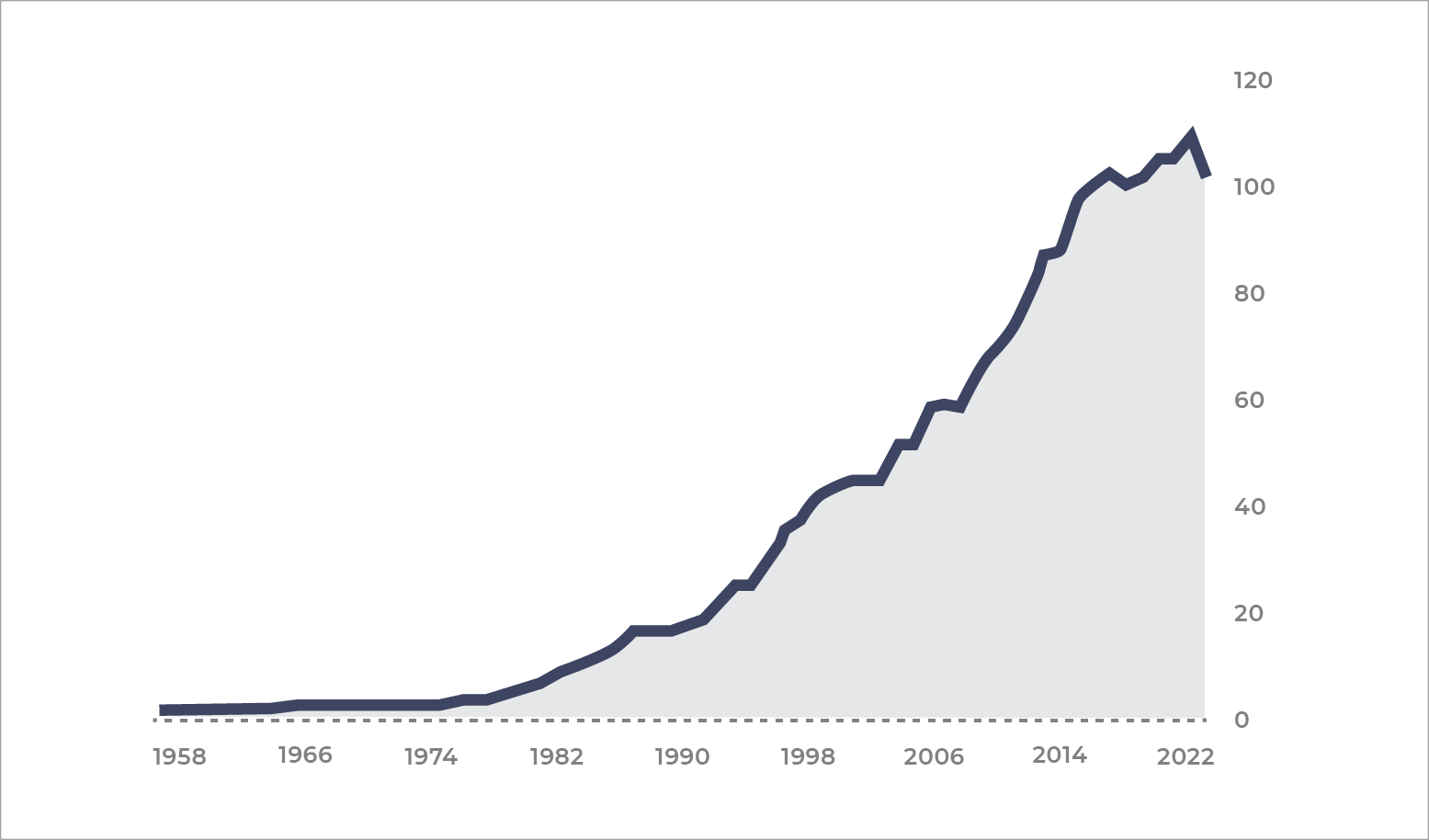
Figure 2. Changes in the number of Islamic organisations in Switzerland from 1958 to 2022 according to the Central Business Name Index.
Figure 2 depicts the growing number of Islamic organisations in Switzerland from 1958 to 2021. The first Islamic organisation was registered in 1958 in Zürich (it was still active in 2022). The growth rate increased in the early 1980s. Over the last twenty years the number of Islamic organisations has more than doubled: from 45 in 2002 to 102 in 2022.
From 2021 to 2022 the number of Islamic organisations decreased from 109 to 102 due to 9 being liquidated and only 2 new ones being registered. However, it should be noted that our data for 2022 is incomplete since it was collected in September 2022 and therefore covers only January to September.
2.3 A List of Swiss Localities and the Corresponding Number of Islamic organisations as of 2022
Table 1 lists the localities and the corresponding number of Islamic organisations with ‘active’ status as of 2022. The localities are listed in the alphabetic order.
Table 1. A list of Swiss localities and the number of Islamic organisations as of 2022
| No | Locality | Number of Islamic organisations |
|---|---|---|
| 1 | Aarburg | 1 |
| 2 | Baar | 1 |
| 3 | Bachenbülach | 1 |
| 4 | Basel | 4 |
| 5 | Bellach | 1 |
| 6 | Bellevue | 1 |
| 7 | Bern | 5 |
| 8 | Buchs SG | 1 |
| 9 | Bürglen TG | 1 |
| 10 | Chavannes-près-Renens | 1 |
| 11 | Dübendorf | 1 |
| 12 | Fribourg | 6 |
| 13 | Geneva | 13 |
| 14 | Giubiasco | 1 |
| 15 | Glattbrugg | 1 |
| 16 | Glis | 1 |
| 17 | Hegnau-Volketswil | 1 |
| 18 | Herzogenbuchsee | 1 |
| 19 | Ittigen | 1 |
| 20 | Lausanne | 2 |
| 21 | Le Lignon | 1 |
| 22 | Liestal | 1 |
| 23 | Lugano | 1 |
| 24 | Muttenz | 1 |
| 25 | Näfels | 1 |
| 26 | Neuchâtel | 2 |
| 27 | Nidau | 1 |
| 28 | Nyon | 1 |
| 29 | Oberentfelden | 1 |
| 30 | Onex | 2 |
| 31 | Prilly | 2 |
| 32 | Regensdorf | 1 |
| 33 | Rheinfelden | 1 |
| 34 | Riebenstein | 1 |
| 35 | Rorschach | 1 |
| 36 | Schlieren | 2 |
| 37 | Solothurn | 1 |
| 38 | St. Gallen | 7 |
| 39 | Urdorf | 1 |
| 40 | Vevey | 2 |
| 41 | Viganello | 1 |
| 42 | Visp | 1 |
| 43 | Watwill | 2 |
| 44 | Winterthur | 4 |
| 45 | Wohlen | 1 |
| 46 | Zeiningen | 1 |
| 47 | Zurich | 16 |
| TOTAL | 102 |
As it can be seen from Table 1, 102 Islamic organisations were active in 47 Swiss localities in 2022. By far the greatest concentrations were in Zürich and Geneva, followed by St. Gallen, Fribourg, and Bern. 70% of the localities had one Islamic organisation.
2.4 Dynamics of the Annual Number of Registered and Liquidated Islamic Organisations in Switzerland from 1958 to 2022
Next, we examined the number of registered and liquidated Islamic organisations in Switzerland from 1958 to 2022.
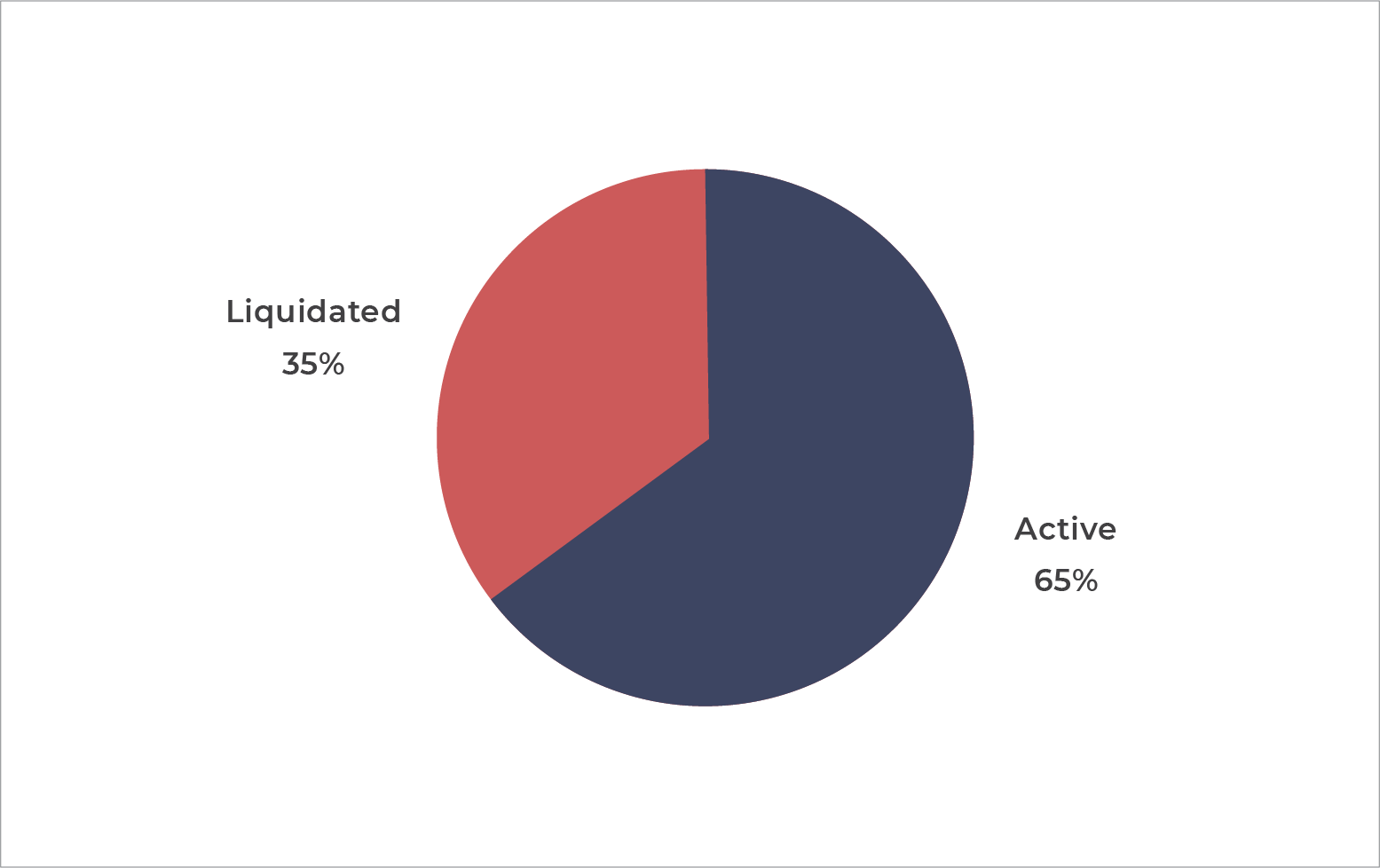
Figure 3. Percentage of active and liquidated Islamic organisations in Switzerland by 2022: 102 active (65%) and 56 liquidated (35%).
Our data suggests that by September 2022, the Swiss Central Business Name Index registered a total of 158 Islamic organisations, of which 102 (65%) were active by 2022 and 56 (35%) liquidated (Fig. 3).
How many new registrations and liquidations of Islamic organisations took place in Switzerland each year from 1958 to 2022 is depicted in Fig. 4. As Figure 4 reflects, the first Islamic organisation was registered in 1958, and there were no new Islamic organisations for eight years till 1966, when one more organisation was registered. Then there is 10 years break before the third Islamic organisation appeared in 1976. But starting from 1979, the intervals between new registrations have progressively shortened. After 1979 one or more Islamic organisations were registered nearly every year with exceptions in 1988-89 and 2004, and since 2005 new Islamic organisations have been registered every year. The year with the most registrations was 2014 (11 new organisations), and the year with the most liquidations was 2022 (9 Islamic organisations liquidated).
Figure 5 depicts the same data, but averaged over decades. It gives the average yearly value for each decade. Thus, an average of 4.4 new Islamic organisations were registered every year during the decade 2001-2010, and an average of 6 new Islamic organisations were registered every year during the decade 2011-2020.
The average number of newly registered Islamic organisations in Switzerland has increased each decade. In the last decade (2011-2020) the average number of new Islamic organisations per year is 1.4 times more than that of the previous decade (2001-2010). If this tendency continues, it can be expected up to 8 new Islamic organisations every year in the current decade (2021-2030). This would result in there being 80 more Islamic organisations in Switzerland by 2030.
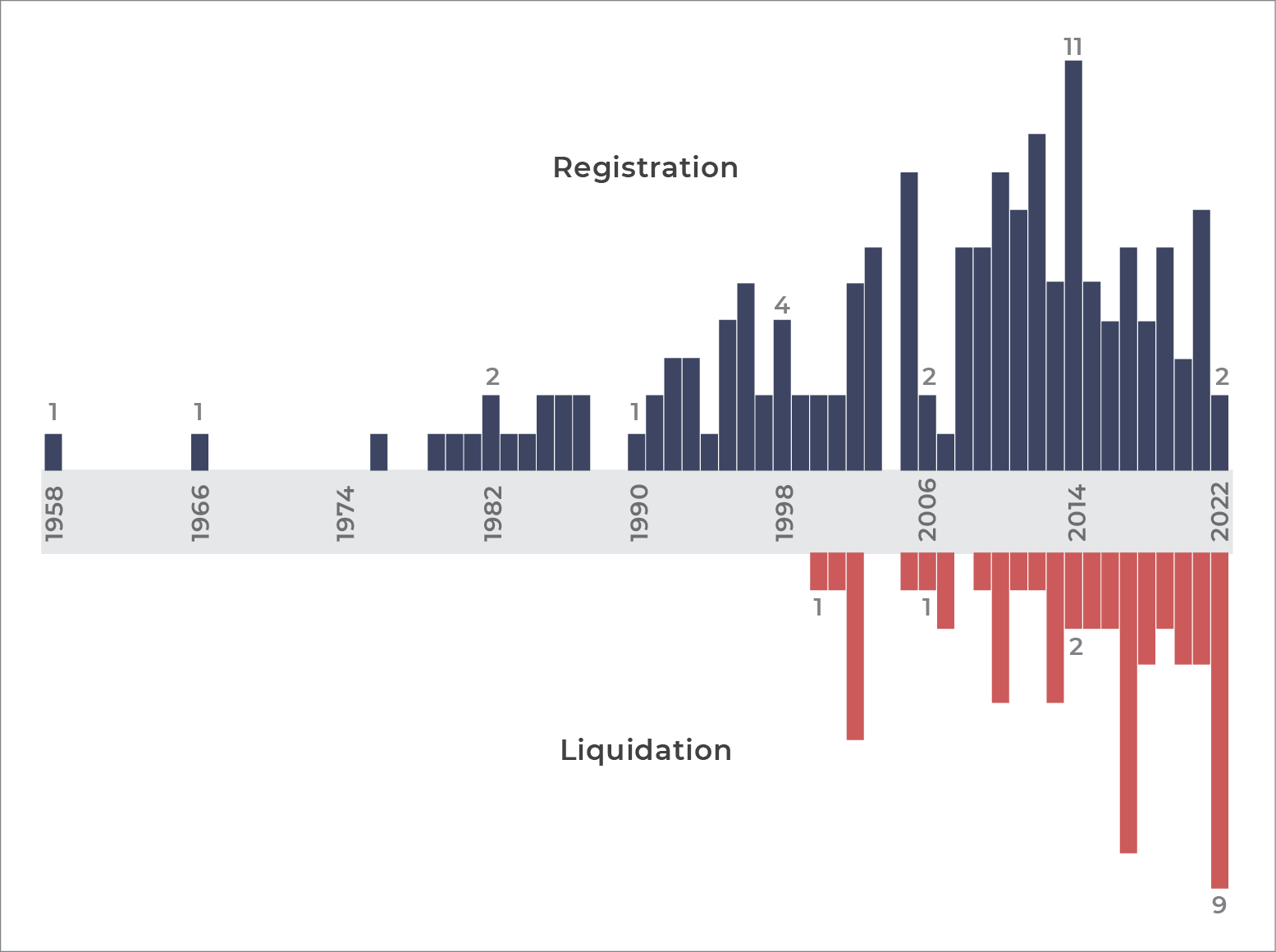
Figure 4. The number of new registrations and liquidations of Islamic organisations in Switzerland each year from 1958 to 2022.
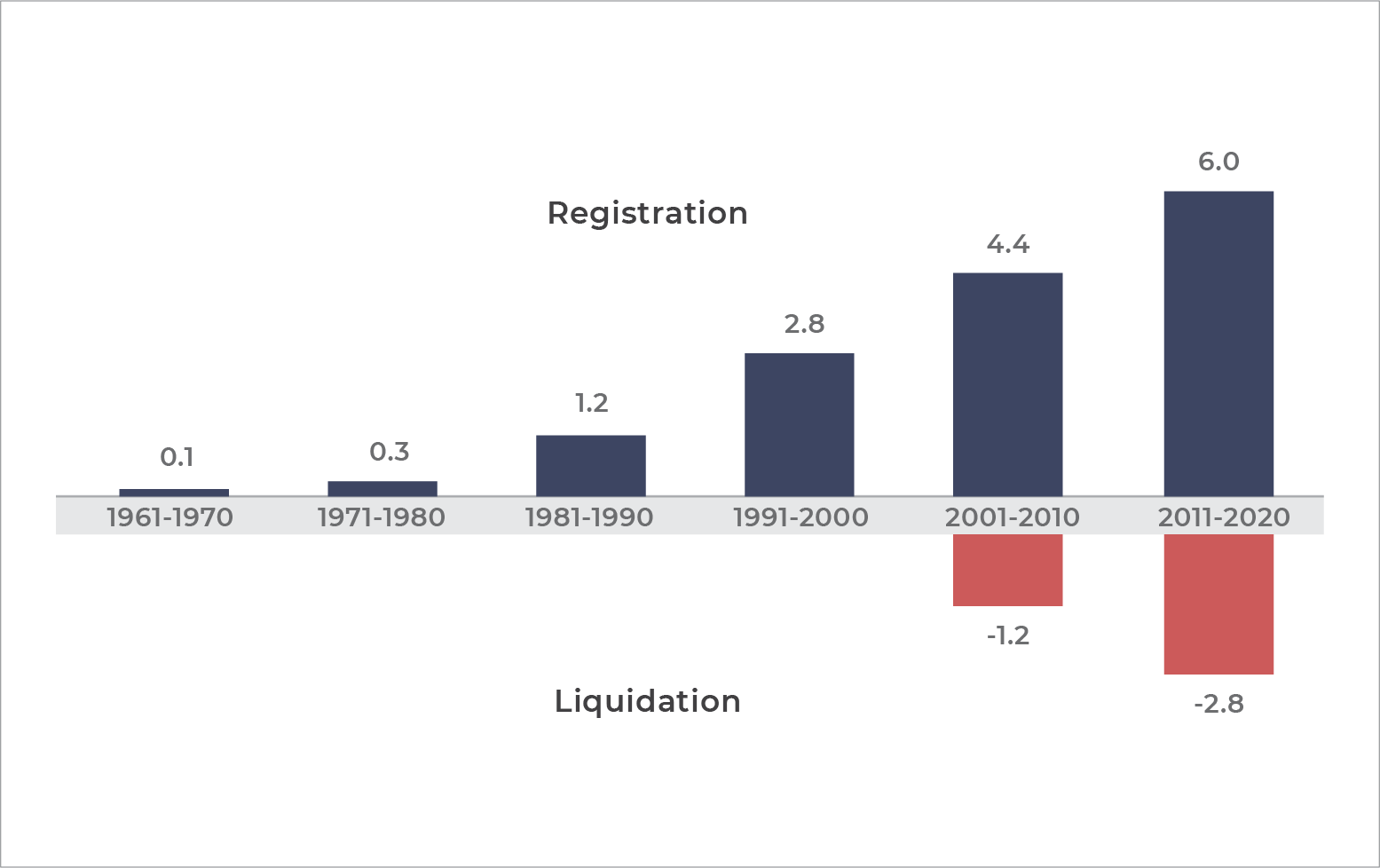
Figure 5. The number of registered/liquidated Islamic organisations in Switzerland per year, on average by decades.
The next question is how many Islamic organisations were liquidated in Switzerland every year. 56 Islamic organisations had been liquidated by 2022, it is 35% of all Islamic organisations registered in Switzerland, as Fig. 3 displays. The analysis of the reasons for these liquidations was beyond the scope of this study. It can be seen from Fig. 4 that the first liquidation of an Islamic organisation occurred in the year 2000. Figure 5 shows that the rate of registration was consistently higher than the rate of liquidation. As you could see in Fig. 5, in the decade 2011-2020, an average of 6 Islamic organisations were registered each year, while an average of 2.8 Islamic organisations were liquidated each year.
Conclusions
The research has found that:
- the number of Islamic organisations in Switzerland has been growing since 1958, and has doubled in the last 20 years;
- 102 Islamic organisations were active in 47 Swiss localities in 2022;
- since 2005 at least one new Islamic organisation has been registered in Switzerland every year;
- in the decade 2011-2020 an average of 6 new Islamic organisations have been registered each year – 1.4 times more than in the previous decade. If this tendency continues, 80 more Islamic organisations can be expected to be registered in Switzerland by 2030.
These findings can help scientists, politicians, political analysts, government officials and community leaders better understand the situation in Switzerland, and ensure that their decisions are well-informed when doing state planning.
Data availability
Data derived from public domain resources.
[dataset] Authors: Federal Office of Justice (FOJ), Federal Registry of Commerce (FRC), Bundesrain 20, 3003 Bern, Switzerland; Access date: 15.09.2022; Data repository or archive: Central Business Name Index; URL https://www.zefix.ch/en/search/entity/welcome
References
- Allievi, S. and Nielsen, J. (eds.): Muslim Networks and Transnational Communities in and Across Europe, Leiden: Brill, doi:10.1163/9789047401780, 2003.
- Banfi, E.: Welfare Activities by New Religious Actors. Islamic Organisations in Italy and Switzerland, Palgrave Macmillan Cham, doi:10.1007/978-3-319-62096-1, 2018.
- Banfi, E.: Genre et racialisation des musulmanes: une analyse des interventions parlementaires en Suisse (2001–2016), In Lépinard, É., Sarrasin, O. and Gianettoni L. (eds.): Gender and Islamophobia. Discrimination, Prejudice and Representations in Europe, 31–55. Lyon: ENS Éditions, doi:10.4000/books.enseditions.18363, 2021.
- Banfi, E. and Gianni, M.: Islamic Organisations in Western Switzerland. Actors, Networks, and Socio-Cultural Activities, Zurich: Seismo Press, doi:10.33058/seismo.30743, 2023.
- Baycan-Herzog, E. and Gianni, M.: What is Wrong with the Swiss Minaret Ban? A Comprehensive Response on Belonging in Post-migration Societies, In Seglow, J. and Shorten A. (eds): Religion and Political Theory. Secularism, Accommodation and The New Challenges of Religious Diversity, 175–194. London: Rowman and Littlefield International, doi:10.1093/jcs/csac030, 2019.
- Bednarz, S., Bockenhauer, M., and Hiebert F.: Human Geography: A Spatial Perspective, Cengage, 2023.
- Cesari, J. (ed.): The Oxford Handbook of European Islam, Oxford University Press, doi:10.1093/oxfordhb/9780199607976.001.0001, 2014.
- Dataset. Authors: Federal Office of Justice (FOJ), Federal Registry of Commerce (FRC), Bundesrain 20, 3003 Bern, Switzerland; Data repository or archive: Central Business Name Index; URL https://www.zefix.ch/en/search/entity/welcome; Access date: 15.09.2022.
- Gianni, M.: Muslims’ integration as a way to defuse the ‘Muslim Question’: insights from the Swiss case, Critical Research on Religion, 4 (1), 21–36, doi:10.1177/2050303216630070, 2016.
- Giugni, M., Michel, N., and Gianni M.: Associational Involvement, Social Capital and the Political Participation of Ethno-Religious Minorities: The Case of Muslims in Switzerland, Journal of Ethnic and Migration Studies, 40(10), 1593–1613, doi:10.1080/1369183X.2013.864948, 2013.
- Ibrahim, A. S.: A Concise Guide to Islam: Defining Key Concepts and Terms, Baker Academic, 2023.
- IslamLandkarte, Islamische Vereine & Moscheen in Österreich, Ein Projekt der Universität Wien Institut für islamisch-Theologische Studien Islamische Religionspädagogik. URL: https://www.islam-landkarte.at/, Access date: 28.02.2022.
- Kortmann, M. and Rosenow-Williams, K.: Islamic Organizations in Europe and the USA. A Multidisciplinary Perspective, Palgrave Macmillan London, doi:10.1057/9781137305589, 2013.
- Kraak, M.-J. and Ormeling, F.: Cartography: Visualization of Geospatial Data (4th ed.), CRC Press, doi:10.1201/9780429464195, 2020.
- La Rosa, D. and Privitera R.: Innovation in Urban and Regional Planning: Proceedings of the 11th INPUT Conference, Volume 1, Springer International Publishing, doi:10.1007/978-3-030-68824-0, 2021.
- Lovell, S., Coen, S., and Rosenberg, M.: The Routledge Handbook of Methodologies in Human Geography, Routledge, doi:10.4324/9781003038849, 2022.
- Monmonier, M.: Mapping It Out: Expository Cartography for the Humanities and Social Sciences, University of Chicago Press, doi:10.7202/022484ar, 1993.
- Monnot, C.: Visibility or Invisibility: the Dilemma of the Muslim Associations of Switzerland, Journal of Religion in Europe, 9(1), 44–65, doi:10.1163/18748929-00901003, 2016.
- Peucker, M. and Ceylan, R. (ed.): Muslim Community Organizations in the West. History, Developments and Future Perspectives, Springer VS Wiesbaden, doi:10.1007/978-3-658-13889-9, 2017.
- Rosenow-Williams, K.: Organizing Muslims and Integrating Islam in Germany: New Developments in the 21st Century, Leiden, Boston: Brill, doi:10.1163/9789004234475, 2012.
- Sanchez-Mazas, V. L.: Muslim Organisations and the Laïcité Challenge in the Canton of Geneva, In Banfi, E. and Gianni, M.: Islamic Organisations in Western Switzerland. Actors, Networks, and Socio-Cultural Activities, Zurich: Seismo Press, doi:10.33058/seismo.30743, 2023.
- Sarrasin, O.: Attitudes Toward Gender Equality and Opposition to Muslim Full-Face Veils, Swiss Journal of Psychology, 75(4), 153–160, doi:10.1024/1421-0185/a000181, 2016.
- Schneuwly Purdie, M.: Islam and Muslims in Switzerland Through the Prism of Religious Visibility and Islamic Militancy, In: Ceylan, R., Mücke, M. (eds): Muslims in Europe. Islam in der Gesellschaft, Springer VS, Wiesbaden, doi:10.1007/978-3-658-43044-3_6, 2024.